

Dr Felipe Krause convenes Infrastructures of Prohibition Workshop
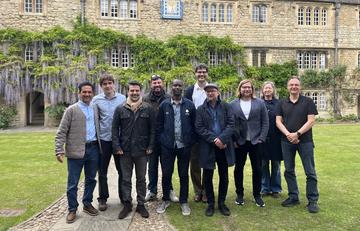
On 7 May 2026, Dr Felipe Krause convened the inaugural workshop of the Infrastructures of Prohibition project, hosted by the Latin American Centre. Held in the intimate and historic setting of St Edmund Hall, the day-long gathering brought together an outstanding group of scholars working across drug policy, prohibition, and governance, representing some of the leading voices on these questions in the UK and beyond.
The workshop is funded by the John Fell Oxford University Press Research Fund, which supports early-stage collaborative research with the potential to open new lines of scholarly inquiry.
The Project
The central question animating the project is deceptively simple: why does prohibition persist? Despite decades of documented failures, the global drug control regime has proven remarkably durable. The Infrastructures of Prohibition project seeks to develop a more systematic account of this persistence — one that moves beyond familiar explanations rooted in US foreign policy or moral ideology, and instead examines the mechanisms through which prohibition is continuously reproduced across institutional, political, and social domains. The concept of "infrastructures of prohibition" directs attention to the bureaucracies, enforcement practices, forms of expertise, political incentives, and everyday social dynamics that keep the system in place.
The Workshop
Rather than a conventional paper-based conference, the workshop was designed as a structured collective discussion, organised around three thematic sessions: the historical and institutional foundations of prohibition; governance, enforcement, and the regulatory apparatus; and the everyday politics and social reproduction of prohibition. A closing roundtable focused on future research directions and opportunities for collaboration.
The format proved generative, producing rich and wide-ranging debate on the role of international treaties as instruments of institutional lock-in, on the multilevel and networked character of drug governance, on the relationship between prohibition and capitalism, on cultural and religious dimensions of drug control, and on the possibilities and limits of reform.
Participants
The workshop brought together a stellar cast of researchers, whose collective expertise spans drug policy, criminology, history, anthropology, sociology, and political science:
- Julia Buxton (Liverpool John Moores University) — Professor of Justice and a leading scholar of drug policy history, gendered enforcement, and drugs and development, with a background as a Latin Americanist
- Maziyar Ghiabi (University of Exeter) — Associate Professor of Social Sciences and Medical Humanities, author of Drug Politics: Managing Disorder in the Islamic Republic of Iran, and Philip Leverhulme Prize winner
- Gernot Klantschnig (University of Bristol) — Professor of International Criminology and leading expert on drugs and the state in Africa
- Toby Seddon (University College London) — Professor of Social Science and one of the UK’s foremost interdisciplinary researchers on drugs, drug policy, and criminal justice, with over thirty years of experience in the field
- Clémence Rusenga (Cardiff University) — researcher on cannabis policy reform, drugs and development in Africa, and the livelihoods of smallholder producers
- Theo di Castri (University of Cambridge) — Junior Research Fellow in the History and Philosophy of Science at Homerton College, working on the history of drug prevention in the Americas
- Jonas von Hoffmann (German Institute for Global and Area Studies, Hamburg) — Research Fellow specialising in drug policy in Latin America, who joined the group from Germany
- Felipe Neis Araujo (University of Manchester) — social anthropologist and Lecturer, with extensive fieldwork experience in Brazil, Jamaica, and West Africa
- Felipe Krause (University of Oxford) — Lecturer in Latin American Studies and Head of the Brazilian Studies Programme, and Principal Investigator of the project
- Tom Driver (University of Oxford) — MSc student in Latin American Studies, working on policing and organised crime in Brazil, and research assistant on the project
What's Next
This was the first event in what promises to be a developing programme of research. More activities — including further workshops, working papers, and collaborative publications — are in the pipeline. Watch this space.
For more information on Dr Felipe Krause’s work, please visit his personal website.

