

Main Seminar: The Political Economy of Industrial Policy in the Andes: The Cases of Ecuador and Peru 1970-2020
Convener(s): Eduardo Posada-Carbo
Speaker(s): Grace Jaramillo, University of British Columbia and LAC
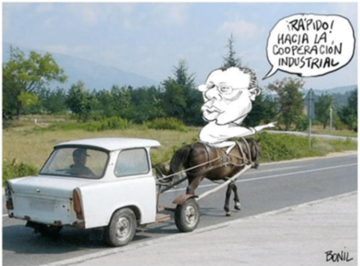
Source: Diario El Universo
Grace Jaramillo is Lecturer at the University of British Columbia’s Master of Public Policy and Global Affairs Program, as well as Honorary Research Associate. Her research tackles one of the long-standing issues of international development, particularly industrial and trade policy in the Global South. She earned her PhD in Political Science from Queen’s University. After completing her degree, she won the prestigious Social Sciences and Humanities Research Council Postdoctoral Fellowship, spending the first year at the Balsillie School of International Affairs at University of Waterloo, and then moving this research project to UBC. Before moving to Canada, she was the head of the Department of International Relations at FLACSO-Ecuador. However, the most important contributions have been in qualitative methods for public policy analysis, including a chapter in the Handbook of Methods for Comparative Policy Analysis and an entry in the Oxford Encyclopedia of Public Administration. Her latest contribution has been Challenges to Democracies in the Andes (2023), alongside Max Cameron.
Abstract: Scholarship on the role of the state and industrialization policies have generally focused on successful cases: the United Kingdom, Germany, Japan and the Asian Tigers, as well as Mexico and Brazil in Latin America, but they have paid little attention to failed cases of industrialization elsewhere. What went wrong with industrial policies in the failed cases in the Andean Region? What are the political causes behind the failure of sectoral development policies, whether import substitution or productive development policies? This research assesses the long and difficult process of industrial policy formulation in two crucial cases in the region: Peru and Ecuador. These countries became atypical cases. First, due to the late adoption of import substitution. Second, because the boom period of these policies emerged under atypical left-leaning military dictatorships in the 1970s, precisely when most authoritarian regimes in Latin America were already aligning with neoliberal reformism. Using comparative historical analysis, my research achieves two objectives: an understanding of long-term patterns of policy reform, including the variables that conditioned cyclical versus path-dependent dynamics of change. Second, a nuance understanding of the direction and leverage of state institutions supporting manufacturing efforts during the emergence, expansion, and consolidation of neoliberal discourse in both countries.

