
Daniel McDonald awarded Franklin Research Grant by American Philosophical Society
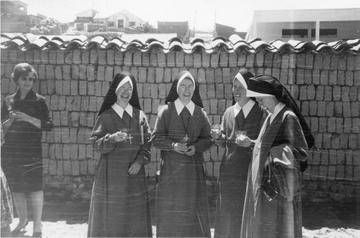
Maryknoll Sisters in Bolivia, n.d. Source: Office of Archives and Records, Archdiocese of St. Louis
The Latin American Centre is pleased to announce that Daniel McDonald, Fulford Junior Research Fellow at Somerville College and LAC faculty member, has been awarded a Franklin Research Grant by the American Philosophical Society, the oldest learned society in the United States.
The Franklin Research Grant will support research in the Maryknoll Mission Archives in Ossining, New York on two missionary congregations, the Maryknoll Fathers and Brothers and the Maryknoll Sisters, as part of a larger project on Cold War-era Catholic transnational networks in Latin America. There, McDonald will consult archives from Maryknoll missions in Ecuador, Bolivia, Nicaragua, Panama, and Mexico as well as these congregations’ relations with the Vatican and national Churches across the Americas. Likewise, this archival work will examine personal collections and accounts to examine how individual missionaries and the Latin American Catholics with whom they interacted articulated new conceptions of personal faith and belief.
This research aims to demonstrate how Maryknollers, widely regarded as exceptionally innovative and forward-thinking missionaries, drew on their experiences in Latin America to shape global conversations about poverty, human rights, and the place of the Church in the modern world. While initially focused on East Asia, Maryknoll shifted focus to Latin America in the 1940s as chronic shortages of clergy and widespread poverty left Catholic leaders fearful that poor and working-class Latin Americans would turn to communism or Protestantism in the absence of the Church.
Rather than a narrow anti-communism, however, this research foregrounds the transnational cultivation of Catholic alternatives grounded in experiences in locales across Latin America. Across their missions, the Maryknoll Sisters and the Maryknoll Brothers and Fathers played key roles in developing a new, more active model of the Church that addressed inequality and promoted both spiritual and material development. As a US-based order with extensive global connections and a prolific press, the experiences of Maryknoll and its missionaries circulated exceptionally widely, contributing to the discussions and events that laid foundations for both the Second Vatican Council (1962–65) and the rise of liberation theology.
In sum, this work supports the larger project aim of tracing how the globalization of the Catholic Church in Latin America coincided with changing ideas about its relationship with the modern world. This project promises to significantly contribute to our understanding of the role of religion in the global Cold War through an analysis of two impactful, yet understudied missionary congregations.

